Longevity and Healthspan Science vs. Tech Bro Biohacking
The longevity industry is currently a “Wild West” of untested claims, overwhelming data, and ever-contested markets. While U.S. lifespan is slowly rebounding post-COVID, healthspan continues to lag due to chronic disease and environmental stressors. To truly advance salutogenesis and catch disease upstream, the ecosystem must move beyond noise and adopt the rigorous N-of-1 data collection models also required for personalized oncology. Amidst the biohacking hyperbole and the medicalization of aging, foundational lifestyle medicine and behavioral change remains our most potent and proven tool for expanding our healthy years.
Table of Contents
The "Wild West" of Longevity & The N-of-1 Imperative
It is the Wild West in terms of services, product companies, longevity clinics, and unsubstantiated medical and wellness claims. There is an abundance of data possible to capture, but what is actually actionable and relevant remains unclear. We are inundated with possible diagnostic tests. End-to-end digital health platforms offering testing, interpretation, product recommendations (such as supplements and repurposed drugs), and virtual physician support are growing into a heavily contested market, slowly threatening even established solo practitioners and practices.
All the while, the environment for the human condition is fraught with stressors, technology, and unregulated chemicals in our air and water. While I am enamored with what may be possible to create and maintain salutogenesis—catching and reversing disease way early upstream—we need to get better at capturing real-world data (RWD) and creating real-world evidence (RWE).
Every company and organization within the longevity and healthspan ecosystem needs this. Clinics, diagnostics, digital platforms, and even the top respected longevity research nonprofits must capture longitudinal data on their patients, clients, and cohorts. The following organizations fit this category of rigor and reputation:
Foundational basic science initiatives (e.g., the Longevity Consortium) identify factors associated with health and disease.
Drug discovery hubs (e.g., the Buck Institute, Scripps Research) discover novel targets and interventions.
A prime example of this foundational rigor is the Longevity Consortium. Supported by ongoing cooperative agreement grants from the National Institute on Aging (NIA)—comprising over $8.6 million annually—the Longevity Consortium functions as a dynamic, multi-institutional network comprising over 60 researchers across 20 different institutions. Rather than chasing isolated biomarkers or trending supplements, this collaborative framework focuses on deeply integrated systems biology to untangle the complex genetic, proteomic, and metabolic factors that drive extreme longevity and healthy aging across diverse human populations.
Their current research aims emphasize actionable translation over raw data collection. By utilizing integrative multi-omics, predictive modeling, and cross-species analysis, the Consortium is focused on developing clinically meaningful biomarkers and identifying viable targets for drug repurposing. Ultimately, their goal is to translate these high-level mechanics into practical therapeutics that actively extend human healthspan.
However, despite their rigor, they lack real-world human testing grounds. Just as we are seeing the inexorable rise of N-of-1 personalized oncology, the longevity and healthspan space requires the exact same infrastructure. To move from hyperbole to hard science, this ecosystem must implement decentralized trials, regulatory-grade registries, Institutional Review Boards (IRBs), and master protocols to systematically capture longitudinal data.
Enjoying this article? Subscribe and get our latest, delivered straight to your inbox.
The Divergence Problem: Lifespan vs. Healthspan
In the U.S., lifespan is finally increasing again since the COVID-19 dip, but the broader U.S. longevity story over the past 50 years reveals a divergence problem. Lifespan has increased, but the quality of those added years has not improved at the same pace.
Lifespan Gains: U.S. life expectancy rose from roughly 72 years in the early 1970s to about 79 years today. Most gains occurred between 1970 and ~2010. Since then, progress has slowed sharply, with periods of stagnation and reversal (Woolf & Schoomaker, 2019).
Healthspan Lags: More years are lived with chronic disease, including cardiometabolic conditions, cardiovascular disease, and cancer survivorship with long-term morbidity. We are seeing an earlier onset of metabolic dysfunction in midlife compared to previous generations. More time is spent in “managed illness” states, even as survival improves.
Personally, I’m not after lifespan; that’s not my goal; it’s a byproduct. To me, years of life are valuable, but only if there is life in the years. I know plenty of octogenarians and nonagenarians with dismal quality of life. My north star is healthspan, not living to 120 while wishing I was gone 40 years earlier!
Population Conditioning and the Medicalization of Aging
The U.S. population is conditioned to expect health conditions requiring various medications, starting in their 30s. Endless pharmaceutical ads help normalize these health trajectories and population conditioning.
I find this all insane. My goal is to live as healthy as possible with a focus on healthspan, then drop dead at a reasonably old age while dreaming about or walking the pristine white beaches of Bora Bora. Or perhaps Portugal’s Algarve. But I digress.
The Hallmarks of Aging: A Clinical Operating System
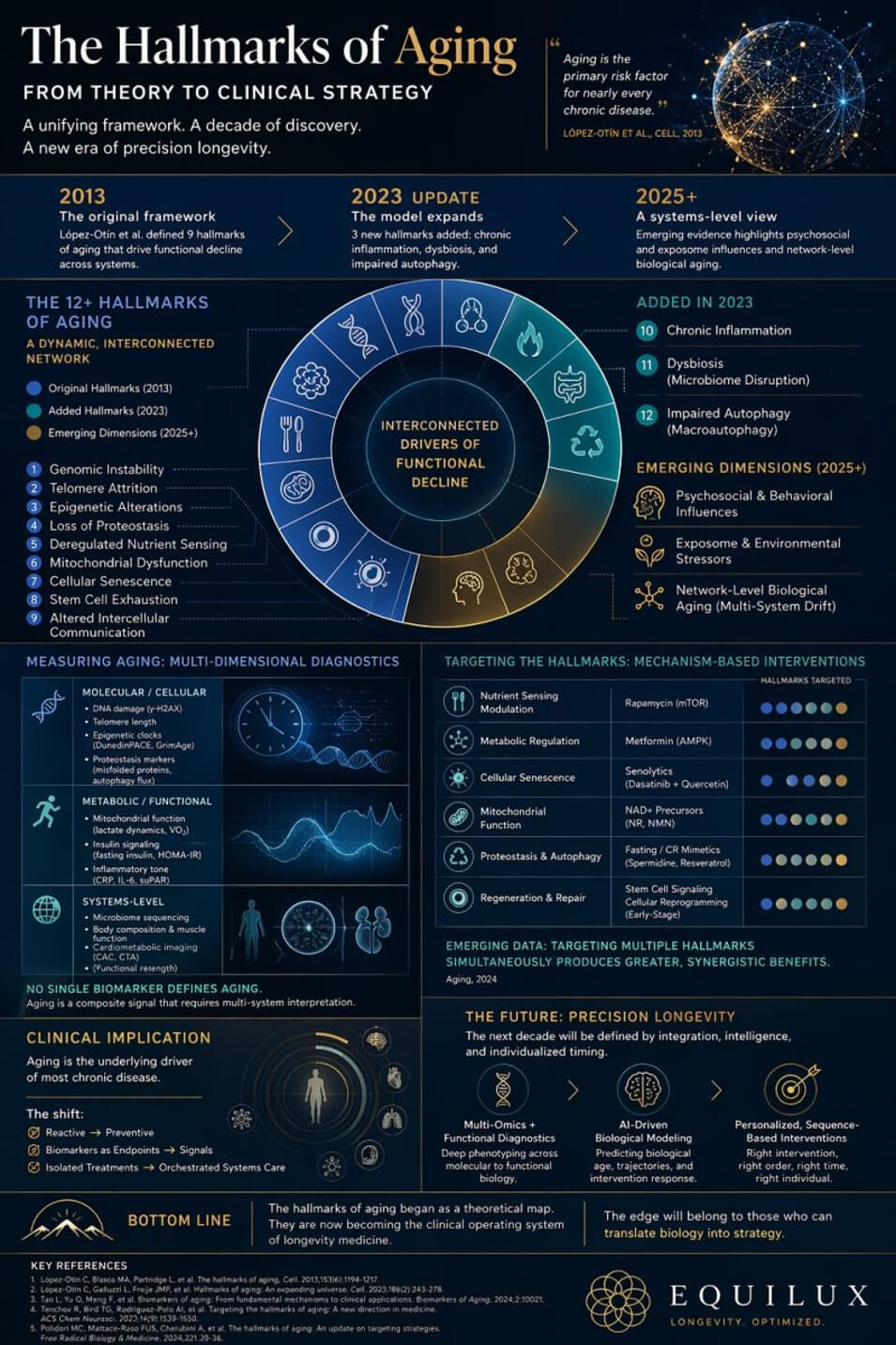
To change this trajectory, we must move away from symptom management and target the root causes of systemic decline. Dr. Stuart M. Diamond applies surgical rigor to systems-level biology, treating the “Hallmarks of Aging” not just as a theory, but as a clinical operating system.
In 2013, nine interconnected biological processes were introduced to provide a unifying explanation for why systems fail over time. By 2023, the model expanded to include chronic inflammation, microbiome disruption, and impaired autophagy, reflecting a shift from static pathways to dynamic system-level biology (López-Otín et al., 2023). Aging is not a list of processes—it’s a network failure.
We are no longer limited to conceptual models; the evolution is now operational. We can quantify aging biology across multiple domains, from epigenetic clocks (like DunedinPACE) (Belsky et al., 2020) and inflammatory signaling (CRP, IL-6) to mitochondrial performance and microbiome diversity. No single metric defines aging; it is a composite signal requiring multi-system interpretation. As Dr. Diamond notes, the next decade will be defined by multi-omics, functional diagnostics, and personalized, sequence-based interventions.
Overtesting and the "Tech Bro" Approach
As a 35-year cancer thriver, I consider myself a biohacker of sorts. I started measuring myriad biomarkers long ago, both to track disease trajectory and to support the host (moi), because you cannot improve that for which you cannot test, measure, and optimize. I like the adage “mo testing is mo bettah,” coined by Bryce Olson as he looked for his next best treatment for advanced prostate cancer through novel testing.
However, we do not yet know what to do with much of the esoteric data marketed for optimizing longevity. While data may be interesting to collect, parse, and analyze, it can quickly become noise, often resulting in wasted time and expense with low actionable yield.
Enter the tech bro biohackers. Entrepreneur Bryan Johnson spends most of his day measuring stuff with the goal of living forever. He measures everything, including his and his son’s erections, daily. Here are a few standout regular tests Johnson pursues that have the weakest and/or mixed science behind them:
Tear Production Monitoring and Nerve Stimulation
Skin Autofluorescence (AGEs) Monitoring
Hyper-Frequent Microbiome DNA Sequencing
Serial Whole-Body MRI for Gray Matter and Bone Marrow Volume
I made it through almost the entire first episode of the Bryan Johnson Netflix docuseries, then turned it off; I had had enough. Conversely, hearing veteran technology journalist Kara Swisher’s candid thoughts on the field of longevity—focused on separating fact from fiction and hyperbole—was an important public service at such a precarious time.
Medical Devices vs. Digital Health Wearables
Medical devices and digital health wearables are different. Medical devices go through an FDA approval process that requires validation through clinical trials because they are used to diagnose or treat disease. Digital health wearables and other wellness devices do not have the same bar to contend with, and the accuracy of many can be questionable.
Though I don’t personally use any digital health wearables, I do often recommend that my cancer coaching clients tracking less than optimal sleep hygiene use a smartphone app. I also have heard nothing but good things about the Oura Ring and current Fitbit technology. These devices can play an important role in fitness and personal health. Furthermore, devices with rigorous validation can play a vital role in the decentralized, N-of-1 clinical trials mentioned earlier, allowing API access to streamline patient-reported outcomes.
The True North: Anticancer Living and Lifestyle Interventions
I do not see the core tenets of longevity, healthspan, lifestyle medicine, anticancer living, and the entire bucket of disease prevention as mutually exclusive endeavors. While our inherited DNA provides a baseline, genetics actually accounts for less than 10% of our longevity (Ruby et al., 2018). The true power lies in the dynamic modulation of gene expression through our daily lifestyle behaviors and actions. Foundational lifestyle approaches drive the vast majority of our healthspan capacity, allowing us to actively influence our biology and build our most resilient selves. The lifestyle medicine literature is most robust on these core pillars:
Clean, unprocessed plant-strong diet
A lean (and mean) frame
Daily vigorous exercise
Stress reduction practices
Quality sleep hygiene
Regular social interactions and community
Clean water and air
General awareness of one’s environment and household products
Select, targeted supplementation and botanicals for healthy aging can also have significant value. It makes complete sense to run a comprehensive set of labs, or terrain testing, especially for micronutrients, oxidative stress, inflammation, and glycemia. Certain repurposed drugs, such as metformin and rapamycin, affect metabolic and aging-related pathways and are being studied for potential roles in aging and cancer biology (Weiss et al., 2018; Barzilai, 2025).
Meanwhile, the most effective interventions with the lowest out-of-pocket costs are the actions you can take in your daily life to strengthen immune function and create your most resilient self. Out of all the content I have read, Dr. Eric Topol’s book, Super Agers: An Evidence-Based Approach to Longevity, is most aligned with the way I look at aging healthfully.
Early Innings: Less is More
We are in the early innings. Yes, you can do all kinds of things like the tech bros—investing globs of time and money chasing longevity—but I strongly advocate for “less is more” as we learn more about what all the data means. Longevity and healthspan science are moving quickly.
Today’s technology, amplified by AI, will allow for explosive growth in investigating the field. I am following this evolution with great interest and active participation—both personally and professionally.
Image created using Nano Banana 2
References
Barzilai, D. A. (2025). Mikhail ‘Misha’ Blagosklonny’s enduring legacy in geroscience: the hyperfunction theory and the therapeutic potential of rapamycin. Aging, 17, 1–15. https://www.aging-us.com/article/206189/text
Belsky, D. W., Caspi, A., Arseneault, L., et al. (2020). Quantification of the pace of biological aging in humans through a blood test, the DunedinPoAm DNA methylation algorithm. eLife, 9. https://pubmed.ncbi.nlm.nih.gov/32367804/
López-Otín, C., Blasco, M. A., Partridge, L., Serrano, M., & Kroemer, G. (2023). Hallmarks of aging: An expanding universe. Cell, 186(2), 243–278. https://doi.org/10.1016/j.cell.2022.11.001
Ruby, J. G., Wright, K. M., Rand, K. A., et al. (2018). Estimates of the heritability of human longevity are substantially inflated due to assortative mating. Genetics, 210(3), 1109–1124. https://pubmed.ncbi.nlm.nih.gov/30401766/
Weiss, R., Fernandez, E., Liu, Y., Strong, R., & Salmon, A. B. (2018). Metformin reduces glucose intolerance caused by rapamycin treatment in genetically heterogeneous female mice. Aging, 10(3), 386–401. https://www.aging-us.com/article/101401
Woolf, S. H., & Schoomaker, H. (2019). Life Expectancy and Mortality Rates in the United States, 1959-2017. JAMA, 322(20), 1996. https://pubmed.ncbi.nlm.nih.gov/31769830/
Glenn Sabin, founder of FON and author of n of 1, is a nationally recognized thought leader who positions health innovators, enterprises, and organizations for sustainable growth. Leveraging deep experience in media, strategy, marketing, and business development—and his own compelling cancer journey—he champions personalized medicine and the generation of real-world data and evidence to help define a new, accessible standard of care. Read Glenn’s story.